We flew to Stockholm. Useful facts:
- It is the largest of the Nordic cities;
- it is almost as clean as Tokyo;
- It is built on 14 islands, so there is a lot of water;
- Everyone speaks English;
-People drive on the right. This is significant, because until 1967 they drove on the wrong (left) side. Pedestrians are almost as observant of stop lights as Japanese. Bicycles probably won't stop for you.
We stayed at The Sparrow. A friendly, quiet, medium-sized hotel.
Visiting so many countries in so few days, we missed more museums than we were able to visit. But Susan started out visiting one high on her list in Stockholm, high on her list and so low on mine that I skipped it entirely. It was to the K.A.Almgren Silk Factory and Museum (a "must-see" for apparently for few people as she was the only person there). It is the only "active" silk weaving mill in the Nordic countries, active as they have an apprenticeship program (for one apprentice) and still have on display the weaving looms and equipment from when the Mill was opened in 1833. The displays explained a lot about the process of industrialization in Sweden and the gradual ending of industrial weaving of cloth in the Nordic countries.
The next day we went to the Modern Art Museum, which wed visited on our previous trip to Stockholm. It's on one of the beautiful little islands connected by a bridge to the city and an easy walk from our hotel. The main exhibit was of the work of Britta Marakatt-Laba, a Swedish Sami textile artist. She is primarily known for her narrative embroidery using motifs from the Sami culture and mythology. We would have loved to buy the book from the exhibit but it weighed about 10 lb, more than we could carry easily!
Susan carefully researches both textile/weaving opportunities (few on this trip given the short time in each stop) but also opportunities to swim. In Stockholm she found a beautiful spa, Centralbadet, a close walk to our hotel, very reasonably priced. Built in 1904, the most beautiful indoor swimming pool, surrounded by decorative tiles, and few swimmers.
After a couple of days we boarded the MV Clio. It was built in 1998 and refurbished in 2016. It can make slightly under 20 mph. It is 328 feet long and has a crew of 60. The captain and a number of his staff were Croatian. Many crew were from Indonesia and India. There was one Nepali. Cabin 418 was our home for the next 10 days. The ship was somewhat smaller than our polar vessels-89 passengers max. And it could dock at all our destinations-no need to need tie on life jackets and maneuver into zodiacs. The passengers were almost without exception white, American, at least middle-aged. Many were retired. I was not quite the oldest.
This was our first trip with Overseas Adventure Travel, a group recommended by many friends. We found them to be very well organized. Our tour leader, a Finnish woman (we were divided into groups of 20) was well-informed and terrific; we always also had a local guide. The people in our group were interesting and fun to travel with and,-very important-always on time!
We sailed more than 800 miles, mostly at night, and visited seven countries. We docked at five capital cities (the other two were inland and inaccessible). The seven, in order: Sweden, Finland, Estonia, Latvia, Lithuania, Poland, Denmark. We also spent two nights at a couple of small islands. Thus little time at each place.
We were divided into four groups of about 20. With our own guide, who was with us the entire time. Ours, Julia, was excellent. Shore time was on buses and mostly on foot. Although the streets were flat and often free of cars, many were cobblestoned--very historical, but hard on the feet. On each land tour, Julia was accompanied by a local guide. Susan had to go back to the swimming pool and sauna we’d visited when we were in Helsinki three years ago. It is right down town, a few minutes from where our ship was docked and Susan will tell you it is NOT to be missed. We did visit the bird that was still sitting on the same statue as three years ago. One advantage of being on such a small ship/vessel is that we docked either downtown or very close so we could walk from the ship to places we were visiting.
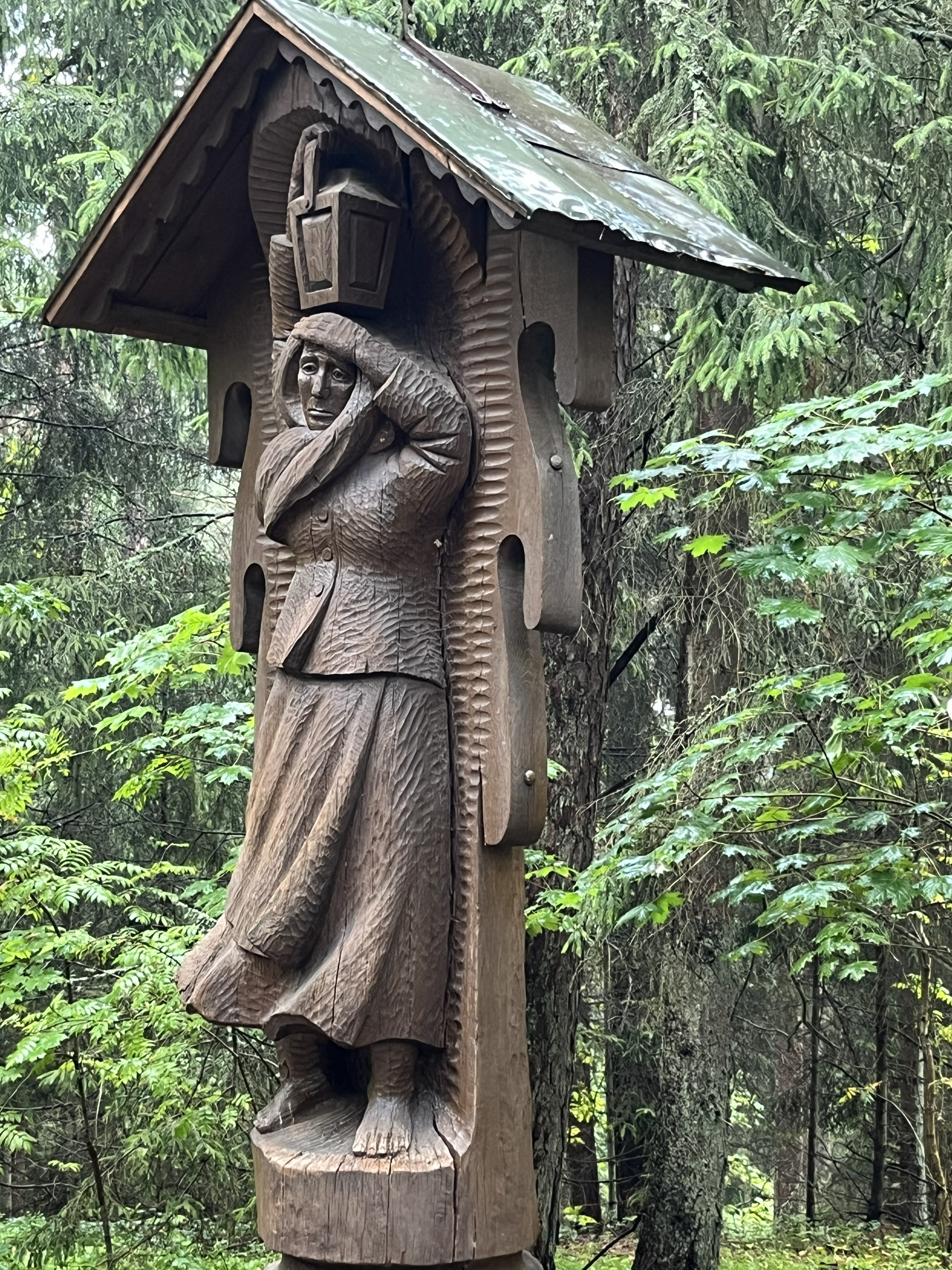
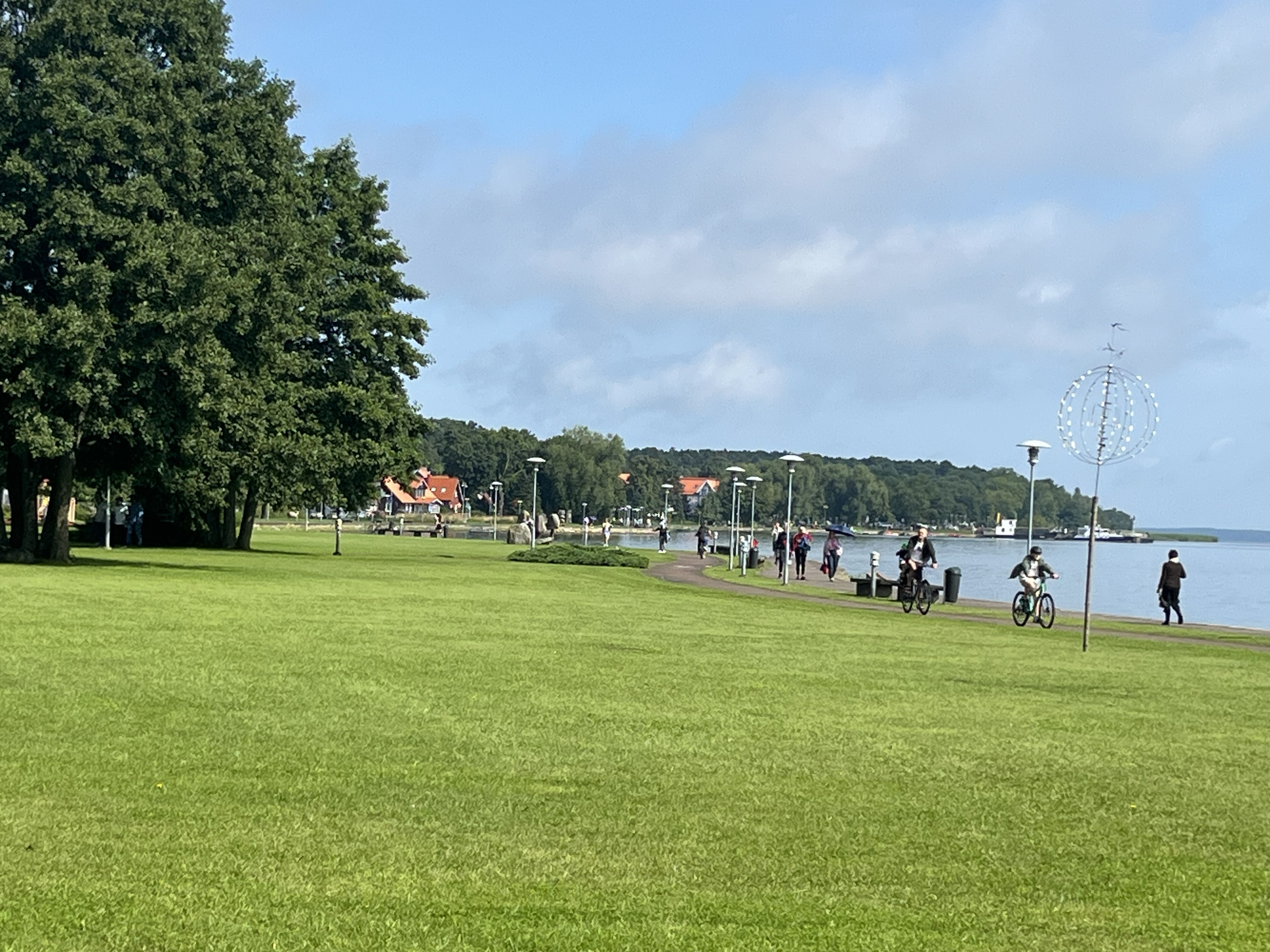
In Lithuania, we climbed the not very steep Hill of Witches. A great many witches, carved in amber, stood menacingly by the trail side. Later we went south by bus along the Curonian peninsula--a long, narrow spit between a large lake and the Baltic Sea. It is very beautiful. If you go far enough, you reach the Russian border. We did not attempt to cross.
In Latvia, we broke into very small groups for dinner with local families. Ours was just outside the capita, Riga. The home had a big, beautiful lawn and trees; it could have graced any American suburb. The hosts were a young couple and their nine-year-old son (an older son was away). We were the first Jewish family they'd entertained and they were the first family we'd met who had family disappeared in Siberia after the War. We learned a lot about the impact of Soviet rule in the Baltics which is much more present than the German occupation which largely and tragically affected the Jewish community.
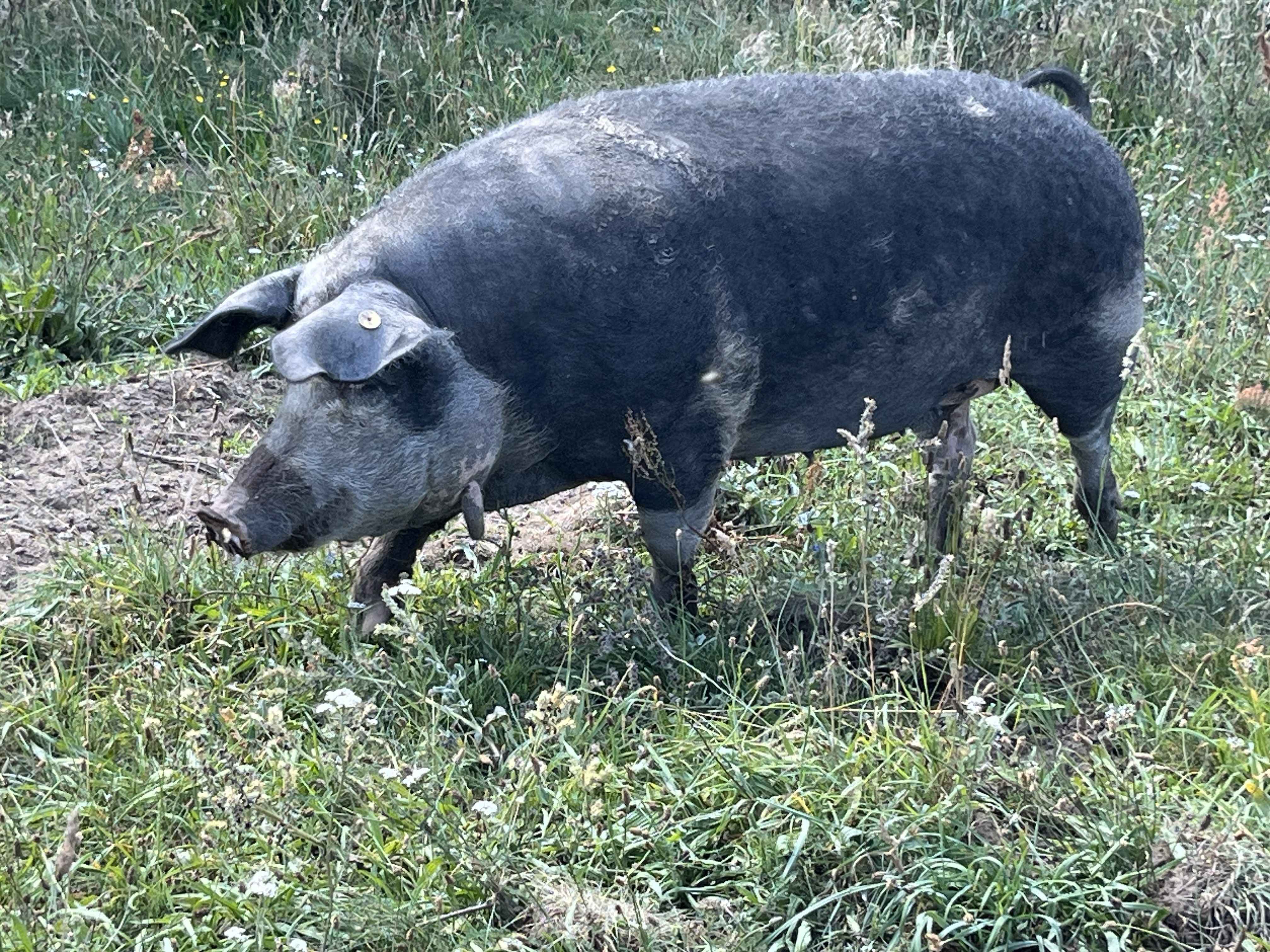
And on the Danish island of Bornholm, we had a lovely outdoor lunch on a farm in the making: salad and focaccia. The farm is the conception of a very eco-friendly young couple. He was at work (they did need some income) while she showed us around the acreage, accompanied by three young geese that kept pecking at her dress. We also visited two female pigs. One was quite big; the other was a lot bigger (see top photo).
The Baltic states had a hard 20th century. First the Soviets overran them, then the Germans, then the Soviets again. A great many Jews were murdered, especially in Lithuania. (For horrifying details, see Chris Heath's recent book, No Road Leading Back.) There was significant local collaboration. Lecturers on the ship did not want to talk about this, but Susan boldly challenged them.
The trip was a challenge to us not in the trekking or the possibility of falling into the Arctic Ocean while getting into a zodiac but in the history of the Baltic countries and their rather enthusiastic participation in exterminating their Jewish population. Lithuania, with the largest number of Jews, was so eager that they annihilated the community even before the Germans invaded. (90% of the 220,000 Jews in Lithuania). However, their occupation by the USSR both before WW 2 and after the German defeat gave them a pass on acknowledging the genocide. There was no attempt to pay restitution to those who fled Lithuania until 1991 and the law is so restrictive that almost no families of survivors are eligible for any payment.
Unsurprisingly, there are far fewer monuments to the Jewish community in the Baltic countries than to the victims of the USSR (and there were numerous victims sent to the gulags). In Tallinn we visited the Memorial to the Victims of Communism with the names of 22,000 murdered or deported Estonians. Quite an impressive and imposing monument. There is a Jewish Museum, which we didn't have time to visit. We visited the Ghetto Museum which opened in the 1990's. Depressing but important history. And much less frequently visited than the Museum of the Occupation of Latvia. We visited only the coast of Lithuania, Klaipeda, where there is a memorial in the old Jewish cemetery established in 1991.
Copenhagen has now, in addition to the fine Jewish Museum, a Museum of the Occupation. And in Stockholm we visited the tiny Swedish Holocaust Museum which opened in 2022.
For those of you who want to know more about the Lithuanians and the Jewish community, Susan recommends Heath's book. We visited the enormous Solidarity Center, which has a lot to say about Lech Walesa. (At the time, Lech was preparing a 30-city lecture tour in the U.S. and Canada.)
Last stop, Copenhagen: the most beautiful city of all.
-------
Addenda:
Latvian women are said to be the tallest in the world. Is this true?
Cool facts about Estonia:
From a postcard:
-Skype was invented here. Really.
-First nation per capita by number of top models.
"The turning point in the Baltic states' fight for freedom was August 23, 1989. That day marked the fiftieth anniversary of the Molotov-Ribbentrop Pact, an agreement signed by Josef Stalin's Soviet Union and Adolf Hitler's Germany in 1939 that divided Europe into spheres of influence and sealed the dark fate of several European nations, including the Baltic states. In protest of the pact and its consequences, people from the three Baltic states formed what became known as the Baltic Way. More than two million people from Lithuania, Latvia, and Estonia joined hands in a breathtaking display of unity. They created a chain stretching more than 430 miles, connecting the Gediminas Tower in Vilnius, the Freedom Monument in Riga, and the Hermann Tower in Tallinn. All of them symbolically stood with their faces turned toward the west and their backs to the east, declaring to the world their choice for freedom."
The Singing Revolution (Wikipedia): "Is the name given to the series of events from 1987 to 1991 that led to the restoration of independence of the three Soviet-occupied Baltic countries of Estonia, Latvia, and Lithuania at the end of the Cold War. The term was coined by an Estonian activist and artist, Heinz Valk, in an article published a week after the 10-11 June 1988 spontaneous mass evening singing demonstrations at the Estonian Tallinn Song Festival Grounds.
"Massive demonstrations against the Soviet regime began after widespread liberalization of the regime failed to take into account national sensitivities. It was hoped by Moscow that the non-Russian nations would remain within the USSR despite the removal of restrictions on freedom of speech and national icons (such as the local pre-1940 flags). However, the situation deteriorated to such an extent that by 1989, there were campaigns aimed at freeing the nations from the Soviet Union altogether. The Baltic peoples staged mass demonstrations against Soviet rule, most notably the Baltic Way of 1989 on the 50th anniversary of the Nazi-Soviet pact. In 1988-89, the three countries proclaimed sovereignty within the Soviet Union, the first republics to do so."
The trip was a challenge to us not in the trekking or the possibility of falling into the Arctic Ocean while getting into a zodiac but in the history of the Baltic countries and their participation in the German exterminating the Jewish population (90% of the 220,000 Jews in Lithuania). However, their occupation by the USSR both before WW 2 and after the German defeat gave them a pass on acknowledging the genocide. There was no attempt to pay restitution to those who fled Lithuania until 1991 and the law is so restrictive that almost no families of survivors are eligible for any payment.
Unsurprisingly, there are far fewer monuments to the Jewish community in the Baltic countries than to the victims of the USSR (and there were numerous victims sent to the gulag). In Tallinn we visited the Memorial to the Victims of Communism with the names of 22,000 murdered or deported Estonians. Quite an impressive and imposing monument. There is a Jewish Museum which we didn't have time to visit. In Riga we visited the Ghetto Museum which opened in the 1990's. Of course, depressing but important history. And much less frequently visited than the Museum of the Occupation of Latvia. We visited only the coast of Lithuania, Klaipeda, where there is a memorial in the old Jewish cemetery established in 1991.
Copenhagen has now, in addition to the fine Jewish Museum, a Museum of the Occupation. And in Stockholm we visited the tiny Swedish Holocaust, which opened in 2022.
Return to travel page.
Return to home page.